.png?width=1080&height=1350&name=Copy%20of%20David%20taylor%20takeaways%20(26).png)
Methodology: We identified two cohorts from Boardspan Board Performance Assessments completed over the last two years: boards whose average scores placed them in the top 20% (High Performers) and those whose average scores placed them in the bottom 20% (Lower Performers). We then compared the two groups across each of the more than 60 governance dimensions measured in the assessment.
1. Alignment, Alignment, Alignment! A Foundation for Success
High Performers scored strategic alignment an astonishing 24 points higher on a 100-point scale than did Lower Performers in the 2024-26 period. In letter grades, the High Performers are in the A/A+ range while the Low Performers give themselves a flat C. The High Performers also score alignment around vision and goals some 20 points higher than those of the Lower Performers.
At Boardpan, we have long argued that alignment is the foundation of board success, and these findings provide some of the strongest evidence we have seen to support that view. It’s quite likely that the more robust alignment recorded by the High Performers is driving better performance in all aspects of governance. It makes intuitive sense that when a board and management team share a clear understanding of the organization’s vision, goals, and priorities, it’s easier to discuss how to attain them, and when everyone is pulling in the same direction, it’s easier to make progress.
On the flip side, boards that aren’t particularly well aligned with each other or with the management team have a harder time with all other facets of board work. Regular board evaluations provide a structured opportunity to surface differences in priorities before they become obstacles to effective governance. Consider a governance responsibility like management succession planning as one example: If the group has different ideas about the company’s direction and goals or the appropriate strategies to achieve them, they will have a hard time establishing the core qualities needed in future leaders or ensuring that development plans or external candidates match evolving needs. Similarly muddied waters will hamper efforts to efficiently execute many governance responsibilities.
It’s worth getting right: Alignment acts as a force multiplier, enabling better strategic discussions, more productive oversight, clearer communication with management, and more effective decision-making across virtually every aspect of governance.
.png?width=587&height=734&name=Copy%20of%20David%20taylor%20takeaways%20(22).png)
Of course, alignment doesn’t require unanimity or preclude healthy challenges and debate. When we think of the High Performers enjoying strong alignment, we might imagine boards populated with people who have diverse opinions and come to discussions with differing viewpoints, ready to engage in a productive debate—not as a group who agree on everything or fall into groupthink. These effective boards invest the time to discuss strategic priorities, share differing perspectives, and listen to others with open-minded curiosity, knowing that these conditions are required to perpetuate long-term alignment. By participating in constructive challenges and pressure-testing vision and goals, they gain the confidence to support them. The directors and management teams of these boards also make the effort to embrace decisions, even when the outcome is different from what they had hoped for, so that the organization can move forward with clarity and commitment and avoid the potential for discord or confusion that comes with re-hashing or second-guessing decisions.
Alignment may be rooted in a common conviction about the value of an organization’s mission, but sustaining it takes willingness to keep leaning into the shared sense of purpose and working through differences of opinion. In other words, alignment doesn’t just happen to high performing boards—board members actively make it happen.
2. Strong Relationships Create Competitive Advantage
Healthy board dynamics, plus strong relationships with the CEO and leadership team, are another area that really sets High Performers apart. The best performing boards scored the topic of board-management relations an impressive 24 points higher on a 100-point scale than did Lower Performers in the 2024-26 period. This was tied with the strategic alignment topic (above) for the biggest differential between the two cohorts in this period. The High Performers give the board-management relationship an A+, while the Lower Performers struggle with a C grade. High Performers also rate board dynamics and the board-CEO relationship some 18 points higher than do Lower Performers.
These findings reinforce an important governance reality: board effectiveness depends not only on the expertise around the table, but also on the quality of the interactions and relationships among board members and with the management team.
Boards rely on management for information, insight, and execution. When the board’s relationships with the CEO and the management team are characterized by trust, mutual respect, clear boundaries, and open communication, information flows more freely, difficult issues surface earlier, and the board is better equipped to provide meaningful oversight and guidance. When relationships are strained, conversations become more guarded, misunderstandings become more likely, and nearly every governance responsibility becomes more difficult.
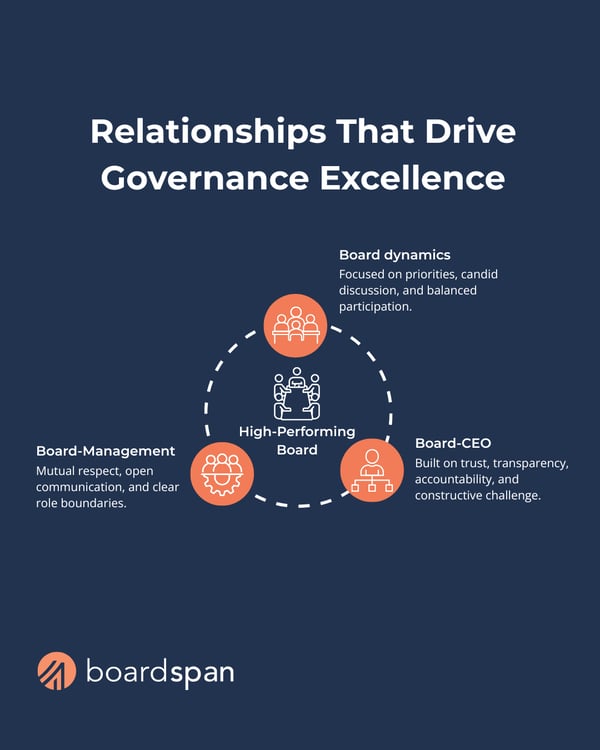
When building and sustaining quality relationships, high-performing boards recognize that what happens outside of the boardroom is as important as what happens in it. They intentionally create opportunities for directors and members of the management team to interact outside the formal board agenda—through pre-meeting dinners, committee work, mentorship relationships, and informal conversations before and after meetings. These interactions foster familiarity, mutual respect, and a deeper understanding of the people responsible for executing the organization's strategy. While the CEO should always be made aware of interactions between board and management team members, and board members should be mindful not to ask for team members to do work that hasn’t been prioritized by the CEO, collaborating on valuable tasks while developing familiarity with one another and building good working relationships can be of tremendous benefit. The good relationships high performing boards enjoy with their CEOs are also cultivated intentionally, through time spent together as a group and individually through periodic 1x1 calls or meetings. Transparency, accountability, and willingness to share “bad news” as well as good are often cited as CEO attributes that promote trusting relationships in which candid conversations can take place, while board members tend to be appreciated by their CEOs for being well prepared, respectful of the distinction between governance and management, and focused on adding strategic value.
The strongest boards also report healthier board dynamics. The boardroom functions best when directors are comfortable asking difficult questions, challenging assumptions, and offering dissenting perspectives without fear that disagreement will become personal. When board members have cultivated personal relationships with each other, they are more likely to assume positive intent and give each other the benefit of the doubt, which can lessen the tension during difficult conversations. At the same time, a strong board chair who keeps the dialogue focused on critical priorities, ensures all voices are heard, and manages challenging discussions artfully will have an enormous positive impact. Boards that can sustain respectful debate tend to benefit from broader thinking and more robust decision-making because competing viewpoints are explored rather than avoided. Healthy dynamics create the trust necessary for disagreements to be productive.
Like alignment, healthy relationships rarely happen by accident. High-performing boards invest intentionally in the interpersonal side of governance. They create opportunities to build trust with one another and the management team, by spending time together outside formal meetings, encouraging candid discussion, clarifying expectations around roles and behavior, and ensure every director has an opportunity to contribute. The Benchmark data suggest these investments have an outsized impact on board effectiveness. Strong relationships don't simply make board service more enjoyable—they make boards more effective, creating an environment where better conversations, better oversight, and ultimately better governance become possible.
3. Great Boards Are Relentlessly Curious About the Future
High Performers distinguish themselves by engaging much more deeply with strategy than Lower Performers. They score strategic planning and strategy evaluation roughly 18 points higher on a 100-point scale, earning grades in the A range while Lower Performers score in the C+ range. Perhaps the most revealing strategic finding, however, involves AI. Even the High Performers rate themselves only moderately effective at understanding and guiding the organization's response to artificial intelligence—a B grade—but that still places them well ahead of Lower Performers, who score themselves at the low end of a D. The strongest boards have moved beyond recognizing AI's importance to building the strategic fluency needed to oversee it.
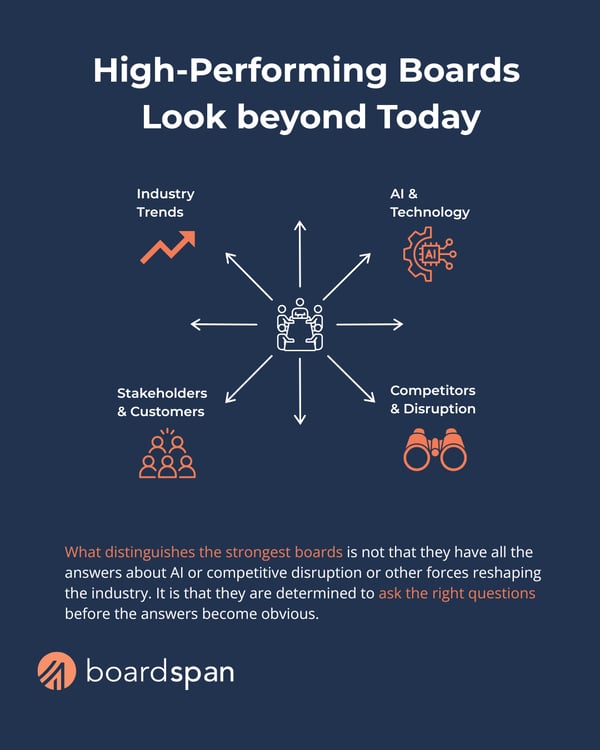
Strategy has always been one of the board's most important governance responsibilities, and it has also become one of its most challenging. As companies navigate rapid technological change, shifting geopolitical conditions, evolving customer expectations, and new competitive threats that can emerge almost overnight, management naturally focuses much of its attention on executing on immediate priorities. An engaged board brings a complementary perspective by stepping back to ask whether today's assumptions will still hold tomorrow, whether emerging risks or opportunities deserve greater attention, and how the organization should position itself for long-term success. They don’t assume that everything will continue as is, but show unrelenting curiosity about what else might happen.
The Benchmark findings suggest that High Performers embrace this role. Rather than limiting strategic discussions to an annual planning session or retreat, these boards are likely to have ongoing dialogue with management about competitive positioning, industry trends, disruptive technologies, and strategic alternatives. They ask probing questions, challenge assumptions, and encourage management to think broadly about changing conditions as a strategic plan is coming together, and after it is approved the board continues to stay involved, seeking to understand how and why execution is or isn’t successful.
The strongest boards may or may not include AI experts, but they make sure they have the knowledge, data, and curious mindset that enables them to envision how the technology may affect their organization's operations, competitive position, workforce, and long-term strategy. While the board will defer to management on how to select technologies or manage implementation, board members help ensure management is thoughtfully considering previously unimaginable opportunities, and risks.
Strong strategic engagement requires directors to maintain an informed view of the competitive environment. A board that understands where competitors are investing, how customer expectations are changing, and what forces are reshaping the industry is better equipped to test strategic assumptions and recognize opportunities that might otherwise be overlooked. This external perspective is one of the board's greatest contributions because directors often bring experiences from multiple organizations and industries that can broaden management's thinking.
What distinguishes the strongest boards is not that they have all the answers about AI or competitive disruption. It is that they are determined to ask the right questions before the answers become obvious. The Boardspan Benchmark findings suggest that high-performing boards devote meaningful attention to the future as well as the present. They engage deeply with strategy, remain curious about forces shaping their organizations, and challenge management in ways that strengthen rather than slow decision-making. In an environment where competitive advantage can shift quickly, boards that consistently elevate the quality of strategic discussion position their organizations to respond more confidently to change and capitalize on emerging opportunities.
Conclusion
Perhaps the most striking finding from this year's Benchmarks is not what separates the best boards from the rest, but where those differences appear. They are found less in the mechanics of governance than in the quality of the board's interactions: alignment around priorities, strong relationships built on trust and respect, and deep engagement with strategy. In other words, the boards that perform best don't simply govern well—they work well together.
The encouraging news is that none of these qualities is fixed. Alignment can be strengthened. Relationships can be cultivated. Strategic engagement can be deepened. The Benchmark findings suggest that board effectiveness is not simply a product of who sits around the table or what governance procedures are in place, but of how intentionally directors choose to work together.
Download This Article
Get a PDF version of this article

Read the Full 2026 Board Performance Benchmark Report

